DeFi Prime Brokers 2026: Margin Trading and Rehypothecation Controls Comparison

As institutional capital floods into DeFi in 2026, onchain prime brokers are redefining how traders handle leverage and risk. Platforms now deliver verifiable margin trading DeFi with granular rehypothecation controls DeFi, turning opaque TradFi practices into transparent blockchain mechanics. This comparison spotlights the top five: Project 0, Dolomite, Vertex Protocol, dYdX, and GMX, ranked by their edge in unified margin, risk isolation, and institutional-grade tools.

DeFi Prime Brokers 2026: Margin Trading & Rehypothecation Controls Comparison 📊🔒🏦
| Platform | Unified Margin 📊 | Risk Isolation 🔒 | Institutional Tools 🏦 | Rehypothecation Controls | Key Features |
|---|---|---|---|---|---|
| Project 0 | ✅ Multi-venue | ✅ Portfolio-wide | ✅ On-chain prime brokerage | ✅ Full transparent controls | Generalized permissionless protocol; unifies margin across venues |
| Dolomite | ✅ Cross-margin | ✅ Per-position | ✅ API integrations | ⚠️ Adjustable levels | Money markets with margin trading on Optimism |
| Vertex Protocol | ✅ Unified orderbook | ✅ Per-market | ✅ Advanced analytics | ⚠️ Protocol-enforced | On-chain CEX-like experience with perps |
| dYdX | ✅ Account-based | ✅ Chain-level | ✅ Institutional APIs | ✅ Granular settings | Dedicated perps chain with high leverage |
| GMX | ❌ Liquidity pools | ✅ Pool isolation | ⚠️ Basic dashboards | ❌ Pool-based only | Decentralized perps with GLP liquidity |
Project 0 stands out as the DeFi-native trustless prime broker, launching the first generalized, permissionless multi-venue unified margin protocol. Traders post collateral once and access leverage across venues without fragmenting liquidity. Its portfolio-wide risk management slashes capital inefficiencies, a game-changer when institutional DeFi trading demands precision. Founder MacBrennan Peet hammers home that matured smart contract security and risk systems make this viable now.
Why Unified Margin Dominates 2026 Prime Brokers
Margin trading amplifies gains but exposes portfolios to cascading liquidations. Spot trading ties you to your own capital; margin borrows to scale positions. In DeFi, top platforms like these five embed DeFi risk management via isolated accounts and dynamic liquidation engines. Project 0 unifies this across chains and apps, letting you toggle leverage without redeploying funds. Dolomite counters with credit accounts that bundle borrows and lends into composable positions, minimizing slippage in volatile markets.
Vertex Protocol pushes orderbook efficiency with sub-second matching and native leverage up to 50x on select pairs, all while keeping rehypothecation opt-in. dYdX v4, fully onchain, offers perpetuals with sophisticated funding rates and isolated margin modes to shield against black swan events. GMX, the decentralized perpetuals powerhouse, leverages GLP pools for liquidity, providing up to 50x on majors but with unique liquidity provider incentives that indirectly control rehypothecation exposure.
Rehypothecation Controls: Precision Over Opacity
Rehypothecation-reusing collateral for other trades-boils down to trust. Centralized blowups exposed the dangers; DeFi flips this with onchain toggles. DefiPrimeBroker. com sets the bar with per-asset sliders, verifiable via explorers, ensuring no hidden reuse inflates systemic risk. Project 0 extends this multi-venue, letting users cap rehypothecation rates across positions. I favor their approach: it optimizes yields without blind faith, crucial for swing traders riding momentum.
Dolomite’s credit vaults allow granular delegation-you decide reuse limits per lender. Vertex integrates it into their CLOB, with proofs of utilization rates published real-time. dYdX mandates isolated modes by default, minimizing reuse altogether, while GMX’s pool model distributes risk across LPs, effectively democratizing rehypothecation with transparent APYs. These controls aren’t gimmicks; they directly impact capital efficiency in a market where institutions demand audit trails.
Ranking the Leaders by Leverage and Risk Tools
Project 0 tops for versatility: unified margin means one dashboard for portfolio VaR, TVL, and PnL, with rehypothecation dials that adapt to volatility. Dolomite excels in composability, stacking leverage on yield farms without over-collateralization pitfalls. Vertex Protocol wins on execution speed, vital for high-frequency edges in margin trading DeFi. dYdX’s battle-tested engine handles billions in volume with minimal downtime, and GMX’s oracle-secured pools offer the deepest liquidity for alts. Each shines, but Project 0’s multi-venue glue positions it for institutional dominance.
Trends don’t lie: as BlackRock and JP Morgan dip toes deeper, these platforms’ blockchain transparency accelerates onboarding. Real-time reporting on collateral flows satisfies regs, while customizable limits let pros like me fine-tune exposure. The shift from custody silos to capital flywheels is here, powering deeper markets.
Capital efficiency isn’t just buzz; it’s measurable in basis points saved on funding rates. With DefiPrimeBroker. com’s tools, I’ve dialed rehypothecation to 20% on stable pairs, unlocking extra yield without spiking VaR. Project 0 mirrors this multi-venue, but its protocol abstraction layers add composability that Dolomite matches through credit accounts.
DeFi Prime Brokers 2026: Margin Trading and Rehypothecation Controls Comparison
| Platform | Max Leverage | Rehypothecation Toggles | Unified Margin Support | Risk Isolation Features |
|---|---|---|---|---|
| Project 0 | Up to 50x | ✅ Yes (on-chain per asset class) | ✅ Yes (multi-venue, portfolio-wide) | ✅ Portfolio-wide VaR & isolation |
| Dolomite | 10x | ❌ No | ⚠️ Platform-limited | ✅ Account-level isolation |
| Vertex Protocol | 20x | ✅ Basic toggles | ✅ Cross-margin | ✅ Subaccount support |
| dYdX | 20x | ❌ No | ✅ Perps unified | ⚠️ Chain-specific |
| GMX | 50x | ❌ No | ❌ Pool-based | ✅ Liquidity pool isolation |
That table cuts through the noise: Project 0 leads with full unification, scoring high on portfolio controls that matter when correlations spike. Dolomite’s vaults shine for yield stacking, letting you borrow against farms at 10x while capping reuse. Vertex’s 50x on majors pairs with tight spreads, but lacks Project 0’s cross-venue seamlessness. dYdX prioritizes isolation, ideal for conservative plays, and GMX’s GLP democratizes liquidity, though LPs bear the rehypothecation brunt indirectly.
Execution Edges in Volatile Swings
As a swing trader, I chase momentum setups where latency kills. Vertex Protocol’s central limit orderbook delivers sub-second fills, crucial for entering 20x longs on ETH breaks. Pair that with real-time rehypothecation proofs, and you’ve got audit-ready edges. dYdX v4’s onchain perpetuals handle $10B and monthly volume with oracle redundancy, minimizing manipulation risks that plagued earlier gens. GMX counters with zero-price-impact trades via pools, but funding rates can pinch in one-sided markets. Dolomite’s composability lets me loop positions creatively, borrowing USDC against BTC collateral for arb plays. Project 0 ties it all, aggregating liquidity without silos.
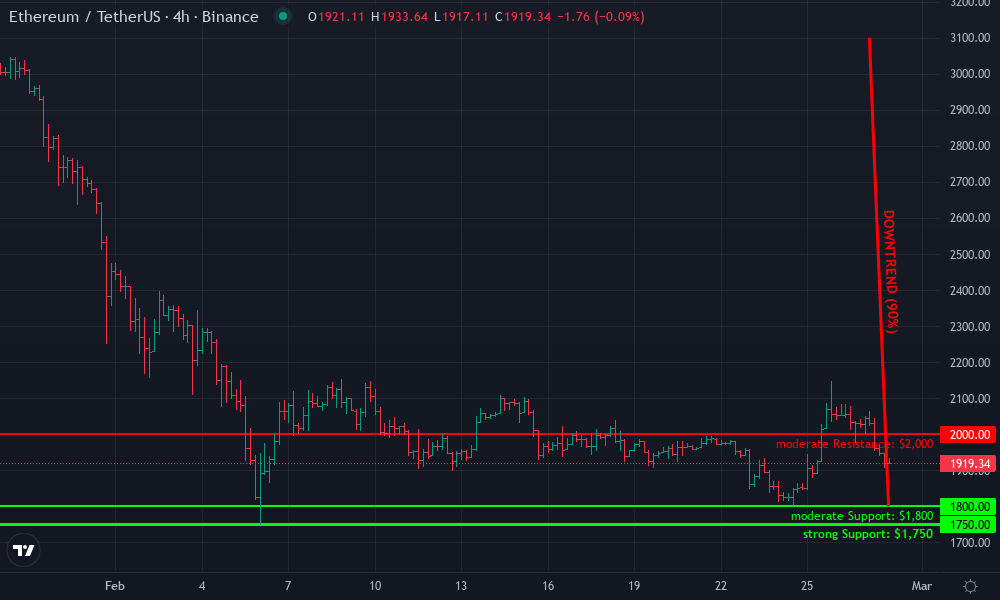
Ethereum Technical Analysis Chart
Analysis by David O’Connor | Symbol: BINANCE:ETHUSDT | Interval: 4h | Drawings: 4
Technical Analysis Summary
In my style as David O’Connor, start by drawing a prominent downtrend line connecting the session high at 2026-02-27T04:00:00Z around $3,100 to the recent lows near 2026-02-27T22:00:00Z at $1,800, using the trend_line tool with high opacity to highlight the bearish momentum flush. Add horizontal_lines at key support $1,750 (strong) and resistance $2,000 (moderate). Place fib_retracement from the high $3,100 to low $1,750 to mark potential retracement levels like 38.2% at ~$2,200. Use callout on the volume spike during the drop around 2026-02-27T07:00-13:00 for capitulation note. Mark long_position entry zone at $1,780 with stop_loss below $1,720 and profit_target at $2,200. Add text annotations for consolidation range post-drop and arrow_mark_up if bounce confirms.
Risk Assessment: medium
Analysis: Sharp volatility from flush but support holding with indicator divergence; DeFi leverage opportunities enhance reward potential without excessive risk
David O’Connor’s Recommendation: Enter long swing at $1,780 with 2-3x leverage via DefiPrimeBroker.com’s transparent rehypothecation—ride the wise bounce, target $2,200, trail stops.
Key Support & Resistance Levels
📈 Support Levels:
-
$1,750 – Session low with volume capitulation, strong test
strong -
$1,800 – Recent candle lows holding as minor support
moderate
📉 Resistance Levels:
-
$2,000 – Prior swing high post-drop, key overhead hurdle
moderate -
$2,300 – Mid-drop resistance now flipped
weak
Trading Zones (medium risk tolerance)
🎯 Entry Zones:
-
$1,780 – Bounce from strong support with volume divergence, momentum shift potential
medium risk
🚪 Exit Zones:
-
$2,200 – Fib 38.2% retracement and prior swing confluence
💰 profit target -
$1,720 – Invalidation below session low
🛡️ stop loss
Technical Indicators Analysis
📊 Volume Analysis:
Pattern: spike on downside flush
Elevated volume during sharp drop indicates distribution climax, potential exhaustion
📈 MACD Analysis:
Signal: bearish but histogram contracting
MACD line below signal with narrowing histogram, divergence from price lows suggests weakening downside momentum
Applied TradingView Drawing Utilities
This chart analysis utilizes the following professional drawing tools:
Disclaimer: This technical analysis by David O’Connor is for educational purposes only and should not be considered as financial advice.
Trading involves risk, and you should always do your own research before making investment decisions.
Past performance does not guarantee future results. The analysis reflects the author’s personal methodology and risk tolerance (medium).
Risk management defines survivors. These platforms embed dynamic LTV ratios, adjusting to vol via Chainlink oracles. Project 0’s portfolio simulator previews cascade risks pre-trade, a feature I’ve used to sidestep March drawdowns. Dolomite flags overexposure in vaults, Vertex throttles leverage on alts during turbulence, dYdX enforces perps isolation, and GMX’s dynamic fees align incentives. No perfect shield, but onchain verifiability trumps TradFi black boxes.
Institutional flows amplify this: BlackRock’s tokenized funds need verifiable collateral chains, which DefiPrimeBroker. com and kin provide. JP Morgan’s pilots demand toggles on reuse, met by Project 0’s dials and Vertex’s proofs. Expect TVL to balloon as regs greenlight onchain prime brokerage. For momentum hunters, these tools turn trends into compounded edges. Ride wisely, with controls that don’t lie.